
Measure binding affinity and kinetics in real-time with the inQuiQ
Label-free biosensing that returns KD, ka and kd from 30 µL of sample. Integrated photonics bring multiplex, high-sensitivity interaction data to your own bench.
One label-free analysis platform for all your binding questions
Engineered Antibodies
Affinity, kinetics, and epitope binning for clone ranking.
Engineered antibodies
Small molecules
& Peptides
Reliable fragment screening and small molecule binding affinity, label-free.
Small molecules and peptides
Molecular Glues
& PROTACs
Protein degraders ternary complex kinetics and molecular glue screening.
Molecular glues and PROTACs
Complex Biological Matrices
Binding analysis in serum, plasma, and crude samples.
Complex biological matrices
Membrane proteins
GPCR ligand binding, lipid bilayer sensors, and construct comparison.
Membrane proteins
Aggregated Proteins
Characterization of aggregated proteins and protein self-association.
Aggregated proteins
Nucleic acids
Aptamer binding affinity, hybridization kinetics, and sequence specificity.
Nucleic acids
Questions about your assay?
Tell us what you're measuring and we'll tell you whether the inQuiQ fits.
Talk to a specialist
Talk to a specialist
Label-free biosensing for every stage of biomolecular research
From early research to advanced development, get reproducible biomolecular binding data without the complexity of traditional instruments.
Academic labs and
Research institutes
Generate reliable binding data for publications and grants. Focus on results, not instrument settings.
Biotech R&D
Screen more candidates, accelerate discovery, and reduce costs with a modular, scalable platform.
CRO and CDMO
Add multiplexed, label-free capacity in a small footprint, so you deliver the reproducible results your clients expect.
The data quality is excellent and highly encouraging. The analytical performance is highly impressive, particularly considering the complexity of the PD-1/PD-L1 interaction studies we do.

Prof. Dr. Norbert Sewald
Organic and Bioorganic Chemistry
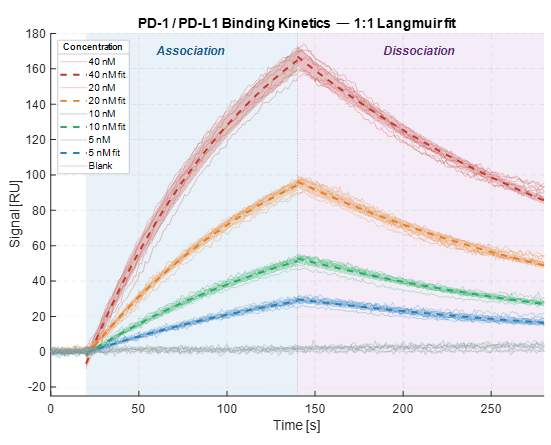
PD-1/PD-L1 binding kinetics
Characterization of PD-1/PD-L1 binding, delivering reproducible kinetic measurements with a KD of 37.7 nM.
From sample to signal
Built around flexible assay setup
The inQuiQ connects flexible sample handling, photonic detection, and real-time data output in a workflow that brings a photonic approach to surface plasmon resonance-style label-free biosensing.
0 1
Sample
Start with the material your lab already has. Purified or crude, filtered through 0.22 µm.
- Proteins, antibodies, and peptides
- Small molecules and DNA
- Serum, plasma, and lysate
- EVs and LNPs
0 2
Flexible 4-Channel Setup
Four channels allow users to flexibly run different assays, conditions, references, or experiments.
1Reference
2Analyte 1
3Analyte 2
4Analyte 3
0 3
Label-free detection on a photonic chip
Binding at the surface shifts the local refractive index. The photonic chip reads that shift and turns it into a signal.
0 4
Real-time binding affinity measurement
Translate interaction behaviour into real-time kinetic and affinity insight.
inQuiQ Software - Sensorgram View
Ch 1
Ch 2
Ch 3
One platform, two instruments
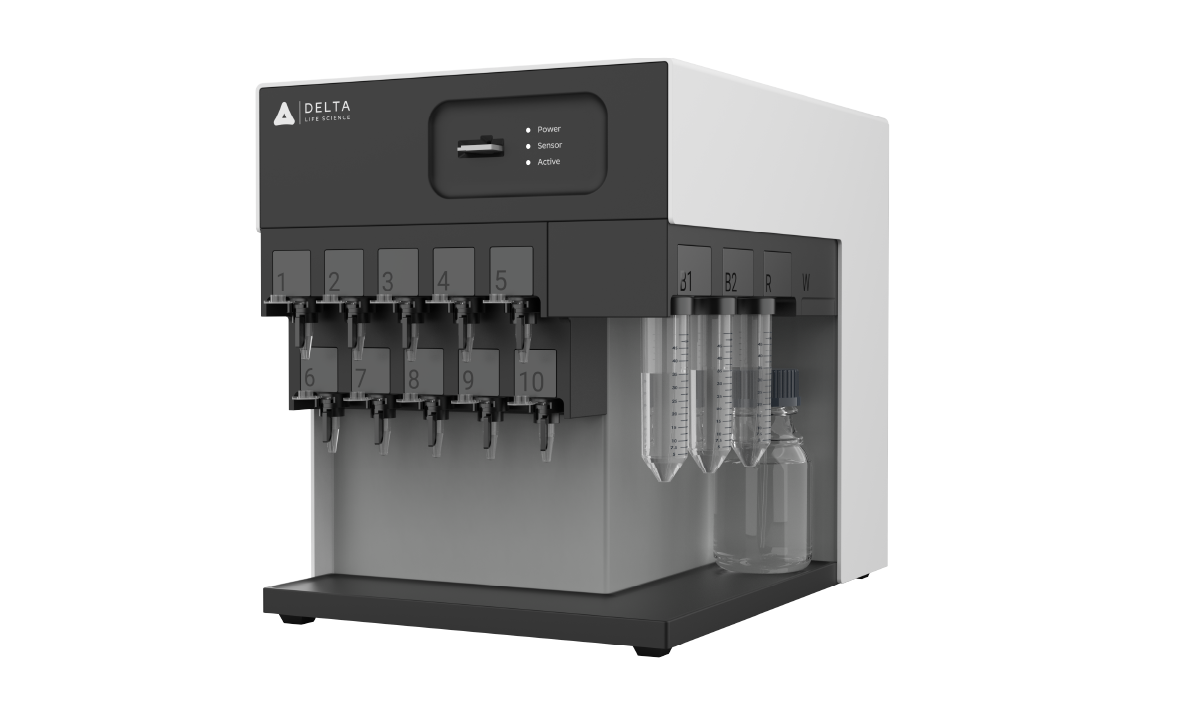
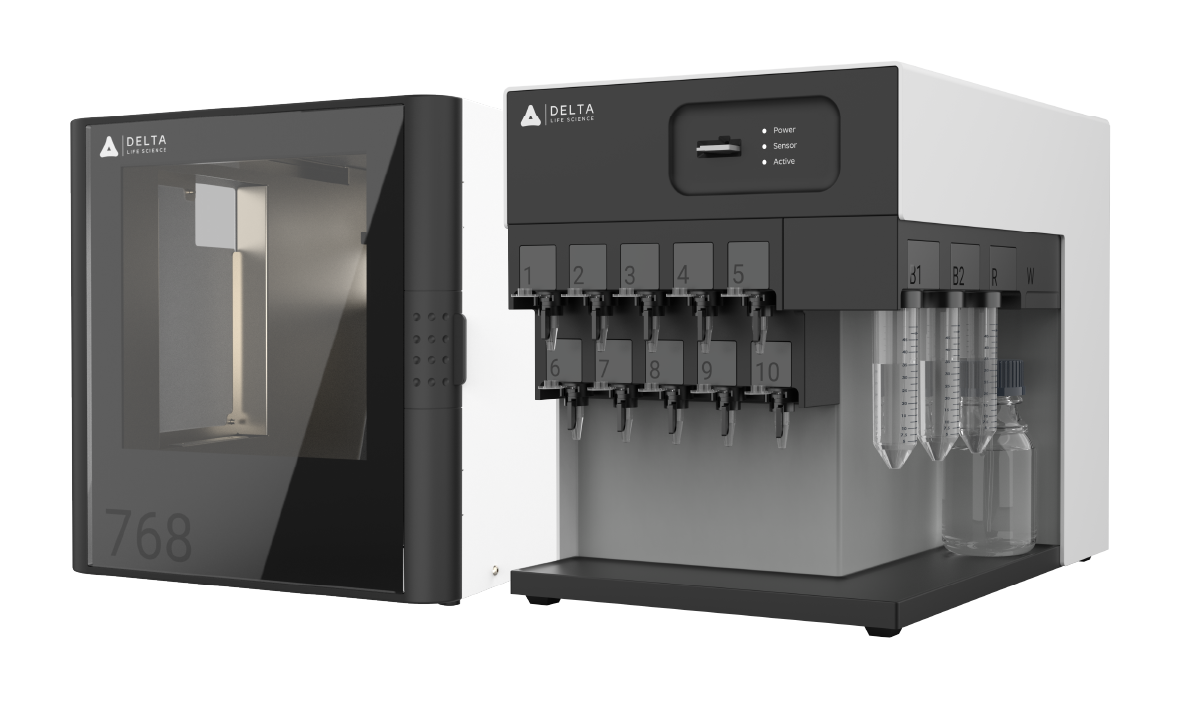
The inQuiQ is a modular platform that grows with your needs. For many, 10 samples unattended is enough. But as your needs grow, the inQuiQ can be easily upgraded with an autosampler, increasing the throughput to two 96- or 384 wellplates.
Why labs are moving beyond surface plasmon resonance & bio-layer interferometry
Surface plasmon resonance
- Scaling requires a new instrument
-
Bulky instrument with at least 1 to 24-hour equilibration
- Gold chip surface challenging for complex matrix assays
- Instrument, service, and specialist cost stacks up
inQuiQ integrated photonics
- Modular platform with high-throughput pathway
- 4-channel flow-cell in a benchtop instrument
- Strong small molecule sensitivity and broad application fit
- Low cost of ownership with photonic technology
Biolayer interferometry
- Dip sensor sensitivity limits weak and small analytes
- Increasing throughput requires a new instrument
-
Only parallel samples, with a single "channel"
- Single-use tips make cost per sample climb
Application notes, publications, and data
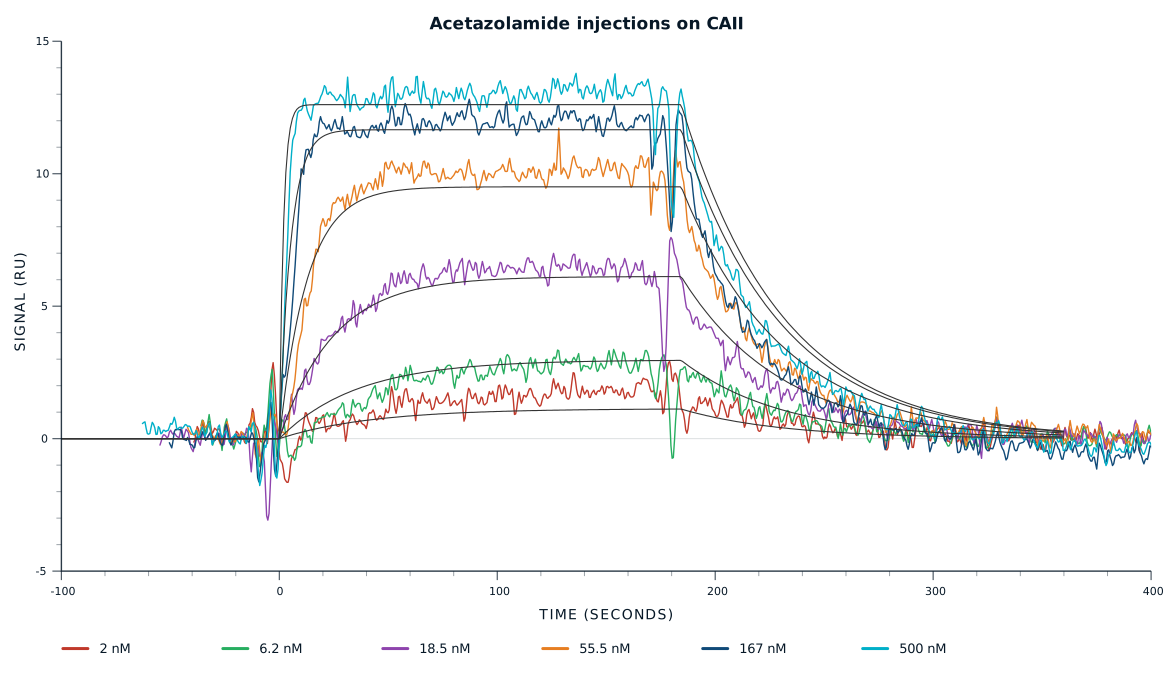
From antibody affinity to small molecule kinetics, explore real binding data generated on the inQuiQ. Each application note pairs a sensorgram with the affinity and kinetic values behind it.
Start A conversation
Tell us about your binding questions
Some teams want to see the instrument run. Others need the numbers first, or a conversation about whether the assay will work at all.
Ready to see the inQuiQ in action?
Talk to an application scientist
Thirty minutes to discuss your assay design, before anyone mentions an instrument.
Download the inQuiQ brochure
Sensitivity, channel layout, footprint, and consumable formats in a couple pages.
Delta Life Science
request@deltalifescience.nl
Send us an email, and we will get back to you as soon as possible.
request@deltalifescience.nl
Send us an email, and we will get back to you as soon as possible.